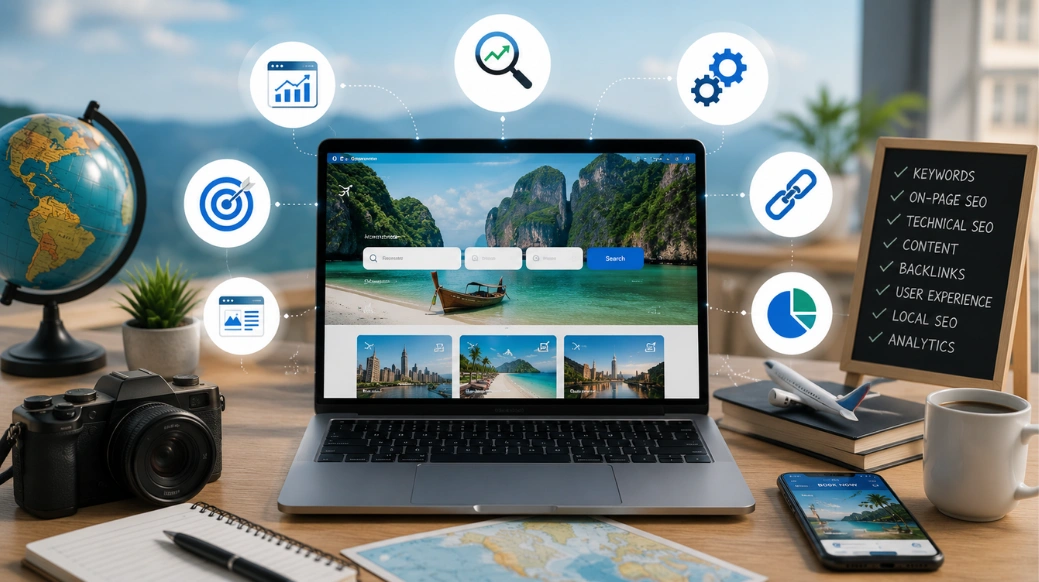
The travel industry is one of the most competitive industries online. Every day, millions of people search for flights, hotels, holiday packages, travel guides, visa information, and tourist attractions. If your travel website doesn't appear on the first page of Google, you're likely losing valuable visitors and potential bookings to your competitors. This is where SEO (Search Engine Optimization) becomes essential. SEO helps your travel website appear higher in search engine results, making it easier for travelers to find your services. A strong SEO strategy not only increases website traffic but also builds trust, improves your brand's visibility, and generates more inquiries and bookings without relying only on paid advertising.
Whether you own a travel agency, tour operator business, hotel booking website, or travel portal, investing in the right SEO strategies can help your business grow consistently. In this guide, you'll learn the most effective SEO strategies for travel websites, including keyword research, content creation, technical SEO, local SEO, link building, and the latest SEO trends that can help your website rank higher on Google.
Why SEO Is Important for Travel Websites
Most travellers begin planning their trips with a search engine. They search for destinations, hotels, tour packages, visa requirements, and travel tips before making a booking.
If your website ranks on the first page of Google, you have a much better chance of attracting qualified visitors who are ready to plan their trip.
SEO offers several long-term benefits, including:
-
More organic website traffic
-
Higher search engine rankings
-
Increased online bookings
-
Better brand visibility
-
Greater customer trust
-
Lower marketing costs
-
Long-term business growth
Unlike paid advertising, SEO continues to bring visitors over time, making it one of the most cost-effective digital marketing strategies for travel businesses.
1. Understand Your Target Audience
A successful SEO strategy starts with understanding your customers.
Think about the people who visit your website and ask questions such as:
-
What destinations are they interested in?
-
Are they looking for budget travel or luxury holidays?
-
Are they planning family vacations, honeymoon trips, or business travel?
-
What information do they need before making a booking?
Understanding search intent helps you create content that answers customer questions and encourages them to choose your services.
For example, instead of targeting only the keyword Dubai Tour Packages, you can create helpful blogs like:
-
Best Time to Visit Dubai
-
Top Tourist Attractions in Dubai
-
Dubai Visa Requirements for Indian Travelers
-
Family-Friendly Places to Visit in Dubai
These articles attract visitors at different stages of their travel planning journey and guide them toward booking a tour package.
2. Perform Smart Keyword Research
Keyword research is the foundation of every successful SEO strategy.
Choose keywords that match what your customers are searching for.
Focus on a combination of:
1. Primary Keywords
These are the main keywords you want to rank for.
Examples include:
-
SEO Strategies for Travel Websites
-
Travel Website SEO
-
SEO for Travel Agencies
2. Long-Tail Keywords
Long-tail keywords are more specific and usually easier to rank for.
Examples include:
-
How to improve SEO for a travel website
-
Best SEO tips for travel agencies
-
Travel portal SEO strategies
-
How to rank a travel website on Google
3. Local Keywords
If your business serves a specific city or region, include local keywords such as:
-
Travel Agency in Bangalore
-
Dubai Tour Packages from Bangalore
-
Kerala Holiday Packages
-
International Tour Packages from Hyderabad
Using a mix of these keywords helps attract more targeted visitors.
3. Create High-Quality Travel Content
Content is one of the most important ranking factors. Google rewards websites that publish helpful, original, and informative content. Create blogs and guides that answer common travel questions and help visitors plan their trips.
Some content ideas include:
-
Destination travel guides
-
Visa application guides
-
Budget travel tips
-
Travel itineraries
-
Packing checklists
-
Hotel reviews
-
Family vacation ideas
-
Honeymoon destinations
-
Seasonal travel guides
-
Adventure travel tips
Instead of writing only promotional content, focus on solving customer problems. Helpful content builds trust and increases the chances of visitors returning to your website.
Optimize Every Page for Search Engines
Each page on your travel website should be optimized for both users and search engines.
-
Use SEO-friendly page titles that include your primary keyword.
-
Write compelling meta descriptions that encourage users to click on your website.
-
Organize your content using proper heading tags such as H1, H2, and H3.
-
Optimize every image with descriptive file names and alt text.
-
Add internal links to related pages, such as linking a destination guide to your tour package page.
These small improvements make your website easier for search engines to understand and improve the overall user experience.
Improve Website Speed
Website speed is an important Google ranking factor.
If your website loads slowly, visitors may leave before viewing your content.
Improve loading speed by:
-
Compressing images
-
Using fast web hosting
-
Reducing unnecessary code
-
Enabling browser caching
-
Using a Content Delivery Network (CDN)
A faster website improves both SEO performance and customer satisfaction.
Make Your Website Mobile-Friendly
Most travelers now search and book trips using smartphones.
Your website should provide a smooth experience on all screen sizes.
A mobile-friendly website should have:
-
Responsive design
-
Easy navigation
-
Fast loading pages
-
Simple booking forms
-
Readable text without zooming
Google uses mobile-first indexing, making mobile optimization essential for better rankings.
Focus on Local SEO
Local SEO helps travel agencies attract customers searching for services in specific locations.
Improve your local SEO by:
-
Creating and optimizing your Google Business Profile
-
Collecting genuine customer reviews
-
Using location-based keywords
-
Displaying accurate contact information
-
Creating city-specific landing pages
For example, if your agency operates in Bengaluru, create pages targeting keywords such as:
-
Travel Agency in Bengaluru
-
Europe Tour Packages from Bengaluru
-
International Holiday Packages in Bengaluru
This increases your chances of appearing in local search results.
Build High-Quality Backlinks
Backlinks remain one of Google's strongest ranking signals.
When trusted websites link to your travel website, search engines view your content as more credible.
You can build backlinks through:
-
Guest blogging
-
Travel directories
-
Tourism websites
-
Business listings
-
Travel influencers
-
Local partnerships
-
Press releases
Focus on earning quality backlinks rather than a large number of low-quality links.
Use Technical SEO Best Practices
Technical SEO ensures search engines can crawl and index your website efficiently.
Important technical SEO practices include:
-
Creating an XML sitemap
-
Optimizing robots.txt
-
Fixing broken links
-
Using HTTPS security
-
Implementing schema markup
-
Improving Core Web Vitals
-
Avoiding duplicate content
A technically optimized website performs better in search results and provides a smoother user experience.
Use Schema Markup
Schema markup helps search engines understand your content and may improve how your pages appear in search results.
Travel websites should consider using:
-
Article Schema
-
FAQ Schema
-
Breadcrumb Schema
-
Organization Schema
-
Local Business Schema
Schema can increase your chances of earning rich results and improving click-through rates.
Track Your SEO Performance
SEO is an ongoing process.
Monitor your website's performance using tools such as:
-
Google Search Console
-
Google Analytics
-
Google Keyword Planner
-
Ahrefs
-
SEMrush
Track important metrics like:
-
Organic traffic
-
Keyword rankings
-
Click-through rate
-
Bounce rate
-
Conversion rate
Reviewing this data regularly helps you improve your SEO strategy over time.
Common SEO Mistakes to Avoid
Many travel websites struggle because of avoidable SEO mistakes.
Some of the most common include:
-
Keyword stuffing
-
Duplicate content
-
Slow website speed
-
Missing meta descriptions
-
Poor mobile experience
-
Broken links
-
Thin or outdated content
-
Ignoring technical SEO
Fixing these issues can significantly improve your website's performance.
Future SEO Trends for Travel Websites
Search engine optimization continues to evolve.
Some important trends include:
-
AI-powered search
-
Voice search optimization
-
Helpful content updates
-
Video SEO
-
Visual search
-
Personalized search results
-
Experience-focused content
-
Core Web Vitals optimization
Travel businesses that adapt to these trends will have a better chance of staying ahead of their competitors.
Frequently Asked Questions
1. What is SEO for travel websites?
SEO for travel websites is the process of improving a website so it ranks higher in search engine results and attracts more organic visitors and bookings.
2. Why is SEO important for travel agencies?
SEO helps travel agencies increase online visibility, attract qualified visitors, generate more inquiries, and reduce reliance on paid advertising.
3. How long does it take to see SEO results?
SEO is a long-term strategy. Most travel websites begin seeing noticeable improvements within three to six months, depending on competition and the quality of optimization.
4. Which keywords should travel websites target?
Travel websites should target destination keywords, service keywords, long-tail keywords, and location-based keywords that match customer search intent.
5. Is blogging important for travel SEO?
Yes. Publishing helpful travel blogs regularly improves search rankings, attracts organic traffic, and builds authority in the travel industry.
6. Does local SEO help travel businesses?
Yes. Local SEO helps travel agencies appear in local search results and attract customers looking for travel services in their area.
Conclusion
SEO is one of the most effective ways to grow a travel website and generate consistent organic traffic. By understanding your audience, choosing the right keywords, publishing high-quality content, improving website performance, optimizing for mobile users, and building strong backlinks, you can improve your search engine rankings and attract more travelers.
Remember that SEO is not a one-time activity. It requires regular updates, performance monitoring, and continuous improvements to stay ahead of the competition. By following these proven SEO strategies, your travel website can increase visibility, attract more qualified visitors, and convert them into loyal customers.
Investing in SEO today will help your travel business build a stronger online presence and achieve sustainable growth in the years ahead.