
Situation: Every Business Wants More Customers Online
Today's customers rely on Google to find products, services, and solutions. Whether someone is looking for a nearby restaurant, a trusted service provider, or the best software for their business, the search often begins online. If your business doesn't appear in those search results, you're likely missing valuable opportunities to connect with potential customers.
Having a professional website is an important first step, but simply launching a website doesn't guarantee visitors or leads. To grow online, businesses need a strategy that helps them reach the right audience at the right time. This is where SEO vs Google Ads becomes one of the most common questions for business owners.
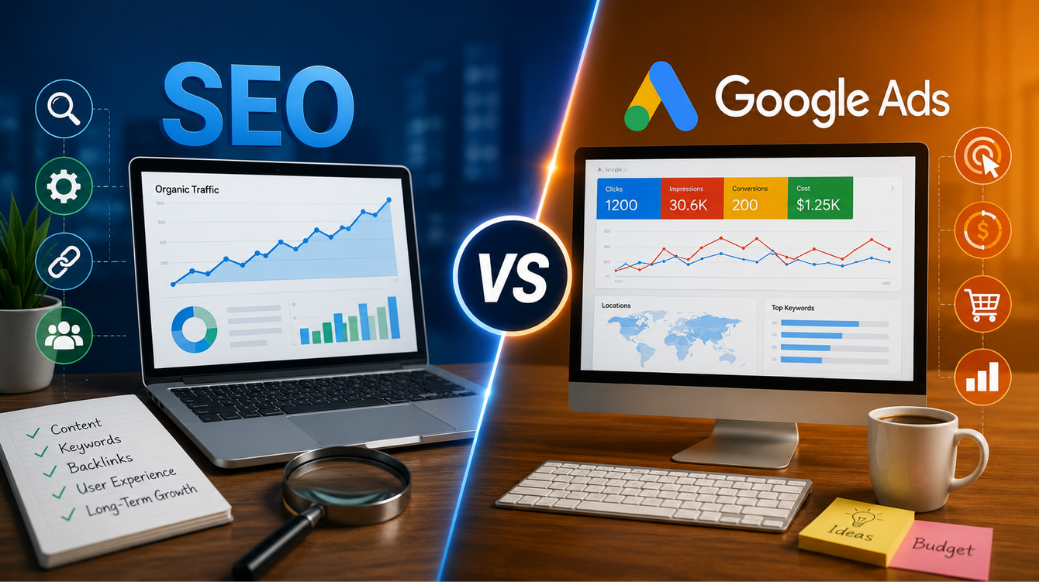
Both Search Engine Optimization (SEO) and Google Ads are designed to increase website traffic, improve online visibility, and generate more leads. While they share the same goal, they achieve it in very different ways.
SEO focuses on improving your website so it appears naturally in Google's organic search results. Google Ads, on the other hand, allows businesses to pay for immediate visibility at the top of the search results. Each approach offers unique advantages, and understanding these differences is essential for making the right marketing investment.
As more businesses compete online, choosing the right digital marketing strategy has become more important than ever. Investing in the right channels can help increase brand awareness, attract qualified leads, and drive long-term business growth.
Complication: Why Choosing Between SEO and Google Ads Is Difficult
Many business owners know they need online marketing, but they are unsure where to invest their budget. Should they focus on SEO services for long-term growth, or should they invest in Google Ads services for immediate results?
This decision isn't always straightforward because both strategies promise increased visibility and lead generation. However, they differ in cost, speed, sustainability, and return on investment.
For example, a newly launched business may need leads quickly to establish itself in the market. In this case, Google Ads can help generate immediate traffic. At the same time, relying only on paid advertising means that traffic often stops as soon as the advertising budget is exhausted.
On the other hand, businesses that invest in SEO can gradually build strong organic rankings, leading to consistent website traffic without paying for every click. The challenge is that SEO requires patience, ongoing optimization, and time before results become visible.
Business owners often ask questions such as:
-
Should I choose SEO or Google Ads?
-
Which strategy provides better return on investment?
-
Which one generates higher-quality leads?
-
Is SEO enough for business growth?
-
Can Google Ads replace SEO?
-
Which strategy is best for small businesses?
These are valid concerns because every business has different goals, budgets, and timelines. Making the wrong decision can lead to wasted marketing spend, lower-quality leads, or missed growth opportunities.
The good news is that there isn't a one-size-fits-all answer. The right choice depends on your business objectives, industry, competition, and long-term vision. By understanding how SEO and Google Ads work, you can make informed decisions that support sustainable business growth.
What is SEO?
Search Engine Optimization (SEO) is the process of improving your website so it ranks higher in the organic (non-paid) search results on search engines like Google. The goal of SEO is to help potential customers find your business naturally when they search for relevant products or services.
For example, if someone searches for "website development company in Bangalore," Google displays websites it considers the most relevant and trustworthy. Businesses that have optimized their websites through SEO are more likely to appear on the first page, where most users click.
SEO is not about manipulating search engines. Instead, it focuses on creating valuable content, improving website performance, and providing a positive user experience. When your website offers useful information and meets Google's quality standards, it has a better chance of ranking higher.
How Does SEO Work?
Search engines use automated programs called crawlers to discover and index web pages. They evaluate various factors to determine which pages should appear for specific searches, including:
-
Content quality and relevance
-
Website speed and performance
-
Mobile responsiveness
-
User experience
-
Internal linking structure
-
Backlinks from trusted websites
-
Technical optimization
The better your website performs in these areas, the greater the chances of achieving higher rankings.
Types of SEO
A successful SEO strategy includes several important areas:
1. On-Page SEO
On-page SEO focuses on optimizing the content and structure of individual web pages. This includes writing helpful content, using relevant keywords naturally, optimizing headings, improving meta titles and descriptions, and creating a clear site structure.
2. Off-page SEO
Off-page SEO involves building your website's authority through backlinks, brand mentions, and online reputation. When trusted websites link to your content, search engines view your website as more credible.
Technical SEO ensures that search engines can easily crawl and understand your website. It includes improving page speed, fixing broken links, optimizing website architecture, implementing structured data, and enhancing security.
4. Local SEO
For businesses serving a specific location, Local SEO helps improve visibility in local search results and Google Maps. Optimizing your Google Business Profile, collecting customer reviews, and maintaining consistent business information are essential parts of local SEO.
Benefits of SEO
Businesses invest in SEO because it offers long-term value and sustainable growth. Some of the key benefits of SEO include:
-
Increased organic website traffic
-
Higher search engine rankings
-
Improved brand credibility and trust
-
Better user experience
-
Lower customer acquisition costs over time
-
Long-term return on investment
-
Higher-quality leads
-
Greater visibility for local and national searches
Although SEO requires time and continuous effort, it creates a strong foundation for long-term business growth by attracting customers who are actively searching for your products or services.
What are Google Ads?
Google Ads is Google's online advertising platform that allows businesses to display paid advertisements across Google Search, YouTube, Google Maps, Gmail, and millions of partner websites.
Unlike SEO, which focuses on earning organic rankings, Google Ads helps businesses appear at the top of search results almost immediately by paying for ad placements. Advertisers typically use a Pay-Per-Click (PPC) model, meaning they pay only when someone clicks on their ad.
For example, if a user searches for "digital marketing company near me," the sponsored listings at the top of the search results are usually Google Ads. These ads provide businesses with instant visibility and can quickly drive targeted traffic to their websites.
How Google Ads Works
Google Ads operates through an auction system. Businesses select relevant keywords, create compelling advertisements, and set a daily or monthly budget. When users search using those keywords, Google evaluates several factors—including bid amount, ad relevance, expected click-through rate, and landing page quality—to determine which ads are shown.
This means that success isn't based solely on spending more money. Well-optimized campaigns with relevant keywords and high-quality landing pages can often achieve better performance while controlling costs.
Types of Google Ads Campaigns
Businesses can choose from several campaign types depending on their goals:
-
Search Ads: Text ads that appear on Google search results.
-
Display Ads: Visual banner ads shown across websites in the Google Display Network.
-
Shopping Ads: Product listings that include images, prices, and store information.
-
Video Ads: Promotional videos displayed on YouTube and other video platforms.
-
Performance Max Campaigns: AI-powered campaigns that optimize ads across all Google channels.
-
Remarketing Ads: Ads shown to users who have previously visited your website, encouraging them to return and complete a purchase or enquiry.
Benefits of Google Ads
Google Ads is an effective solution for businesses looking for quick results. Some of the key advantages include:
-
Immediate online visibility
-
Fast lead generation
-
Precise audience targeting
-
Flexible budget control
-
Geographic and device targeting
-
Measurable campaign performance
-
Easy optimization based on real-time data
For businesses launching new products, promoting limited-time offers, or entering competitive markets, Google Ads for business can deliver rapid exposure and measurable outcomes. However, because traffic depends on ongoing advertising spend, Google Ads is often most effective when combined with a long-term SEO strategy.
SEO vs Google Ads – Which Delivers Better Business Results?
After understanding how SEO and Google Ads work, the next step is to compare them side by side. While both strategies help businesses increase website traffic and generate leads, they differ in cost, speed, sustainability, and return on investment.
The best choice depends on your business goals, marketing budget, and how quickly you want to see results. Let's explore the key differences.
SEO vs Google Ads: Quick Comparison
|
Feature |
SEO |
Google Ads |
|
Cost |
No cost per click, but requires ongoing optimization |
Pay for every click on your ads |
|
Time to Results |
Usually 3–6 months or longer |
Results can start within hours or days |
|
Traffic Source |
Organic search results |
Paid advertisements |
|
Long-Term Value |
High, with lasting benefits |
Stops when the advertising budget ends |
|
Brand Trust |
Higher because users trust organic rankings |
Lower than organic listings, as users know they are ads |
|
Return on Investment (ROI) |
Excellent over the long term |
Strong for short-term campaigns when managed well |
|
Lead Quality |
High-quality leads from users actively searching |
High when targeting the right keywords and audience |
|
Maintenance |
Requires regular content updates and optimization |
Requires continuous budget and campaign management |
|
Scalability |
Gradual and sustainable |
Can scale quickly by increasing budget |
|
Best For |
Long-term business growth |
Immediate visibility and lead generation |
Both strategies are valuable, but they solve different business challenges.
Major Differences Between SEO and Google Ads
1. Cost
One of the biggest differences is how you pay.
- With SEO, you invest in website improvements, content creation, keyword research, and optimization. Once your website ranks well, you can receive consistent traffic without paying for every visitor.
- With Google Ads, every click has a cost. The price depends on your industry, competition, and keyword demand. While you can control your budget, traffic stops when you pause your campaigns.
Best Choice:
-
SEO for long-term cost efficiency
-
Google Ads for immediate results
2. Time to See Results
- SEO is a long-term investment. Search engines need time to crawl, index, and evaluate your website before rankings improve. Depending on your competition, noticeable results may take several months.
- Google Ads works much faster. Once your campaign is approved, your ads can appear on Google Search almost immediately, making it ideal for businesses that need quick visibility.
Best Choice:
-
SEO for long-term growth
-
Google Ads for fast lead generation
3. Website Traffic
- SEO generates organic traffic, meaning users find your website naturally through search results. This traffic often continues growing as your rankings improve.
- Google Ads generates paid traffic, which starts immediately but depends entirely on your advertising budget.
- Businesses using SEO usually build a stable source of visitors over time, while Google Ads provides instant but temporary traffic.
4. Brand Trust and Credibility
- Many users trust websites that appear naturally in Google's search results because they view them as more reliable and authoritative.
- Although Google Ads appears at the top of the page, some users skip sponsored results and click organic listings instead.
- Publishing helpful content, earning backlinks, and improving your website through SEO helps build long-term trust with both customers and search engines.
5. Return on Investment (ROI)
- SEO generally provides a higher return on investment over the long term because your rankings continue attracting visitors without ongoing advertising costs.
- Google Ads can also deliver excellent ROI, especially when campaigns target high-converting keywords and well-designed landing pages. However, continuous spending is required to maintain results.
- Businesses looking for sustainable growth often combine both strategies to maximize ROI.
6. Lead Generation
- Both SEO and Google Ads can generate quality leads, but they work differently.
- SEO attracts users who are researching products or services and are often ready to make informed decisions. These visitors typically spend more time exploring your website.
- Google Ads targets users based on keywords, location, demographics, and interests, making it easier to attract customers with immediate purchase intent.
7. Long-Term Business Value
- SEO continues delivering value even after months or years of optimization. High-quality content can attract visitors long after it is published.
- Google Ads delivers excellent short-term performance but stops generating traffic once the campaign budget is exhausted.
- If your goal is long-term business growth, SEO offers greater sustainability.
Benefits of SEO
SEO remains one of the most effective digital marketing strategies for businesses that want consistent online growth.
Why Businesses Invest in SEO
-
Increases organic website traffic
-
Improves Google search rankings
-
Builds brand credibility and trust
-
Generates high-quality leads
-
Delivers long-term return on investment
-
Reduces customer acquisition costs over time
-
Improves website usability and user experience
-
Helps businesses compete with larger competitors
-
Supports local, national, and global visibility
-
Continues generating traffic without paying for every click
Another major advantage of SEO is content marketing. Publishing valuable blogs, service pages, and educational resources helps answer customer questions, improves search rankings, and positions your business as an industry expert.
Over time, businesses that consistently invest in SEO often experience steady growth in website traffic, enquiries, and sales.
Benefits of Google Ads
Google Ads is an excellent choice for businesses that need immediate visibility and measurable results.
Advantages of Google Ads
-
Delivers instant website traffic
-
Generates leads quickly
-
Targets specific keywords and customer intent
-
Allows precise location targeting
-
Controls advertising budget easily
-
Supports mobile, desktop, and tablet users
-
Provides measurable campaign performance
-
Enables A/B testing for ads and landing pages
-
Increases visibility during promotions and product launches
-
Supports remarketing campaigns to previous website visitors
Google Ads is particularly effective for businesses running seasonal campaigns, limited-time offers, or launching new products where immediate exposure is essential.
Organic Traffic vs Paid Traffic
Understanding the difference between organic traffic vs paid traffic helps businesses decide where to invest their marketing budget.
|
Organic Traffic |
Paid Traffic |
|
Comes from SEO rankings |
Comes from Google Ads |
|
No payment per visitor |
Pay for every click |
|
Builds long-term visibility |
Provides immediate visibility |
|
Higher customer trust |
Fast lead generation |
|
Sustainable over time |
Stops when ads stop |
|
Improves with ongoing optimization |
Depends on advertising budget |
1. Organic Traffic
Organic traffic comes from users clicking your website naturally in search results. Since these visitors actively searched for your products or services, they often engage more with your content.
Organic traffic grows gradually but provides long-term value.
2. Paid Traffic
Paid traffic comes through Google Ads campaigns. It allows businesses to reach customers immediately, even for highly competitive keywords.
Paid traffic works well when businesses need quick enquiries, event registrations, or product sales.
Which One Performs Better?
There is no universal winner.
Organic traffic is ideal for businesses focused on sustainable growth, while paid traffic is perfect for immediate lead generation. Many successful companies use both to maximize visibility and conversions.
Which Strategy Is Better for Different Businesses?
Every business has different goals, budgets, and customer journeys. Choosing between SEO and Google Ads depends on your specific needs.
1. Startups
New businesses often need visibility quickly while building their brand.
Recommended Strategy:
Google Ads for immediate traffic, supported by SEO for long-term growth.
2. Small Businesses
Small businesses usually work with limited marketing budgets and need sustainable growth.
Recommended Strategy:
Focus on SEO first to build long-term organic visibility, while using Google Ads selectively for important campaigns or local promotions.
3. Local Businesses
Businesses such as clinics, restaurants, salons, and service providers benefit greatly from appearing in local search results.
Recommended Strategy:
Local SEO combined with Google Ads for location-specific searches.
4. E-commerce Businesses
Online stores face intense competition and often need both immediate sales and long-term visibility.
Recommended Strategy:
Combine SEO with Google Shopping Ads and Search Ads to maximize traffic and conversions.
5. B2B Companies
Business-to-business companies usually have longer sales cycles, where buyers research before making decisions.
Recommended Strategy:
SEO should be the foundation, supported by Google Ads for high-value keywords and lead generation campaigns.
6. Service-Based Businesses
Businesses offering services such as website development, digital marketing, legal consulting, or healthcare need to build trust before customers make enquiries.
Recommended Strategy:
A combination of SEO for authority and Google Ads for immediate lead generation delivers the best results.
When Should You Choose SEO?
SEO is the right choice if your goal is to build a strong online presence that delivers consistent results over time. Although it requires patience and ongoing optimization, the long-term benefits often outweigh the initial effort.
Choose SEO when:
1. You Want Long-Term Business Growth
If you're planning to grow your business for years rather than weeks, SEO is one of the most cost-effective marketing strategies. A well-optimized website can continue attracting visitors without paying for every click.
2. You Want to Build Brand Authority
Businesses that consistently publish helpful content and rank on the first page of Google are often viewed as more trustworthy by customers.
3. You Have a Limited Advertising Budget
Unlike paid ads, SEO doesn't require payment for each visitor. While there are optimization costs, the long-term return on investment is generally higher.
4. Your Customers Research Before Buying
If customers compare products, read reviews, or research services before making a purchase, SEO helps your website appear throughout their buying journey.
5. You Want Sustainable Website Traffic
SEO builds a steady flow of organic traffic that continues even when you're not actively running advertising campaigns.
When Should You Choose Google Ads?
Google Ads is ideal when speed is a priority. It helps businesses reach potential customers almost immediately after launching a campaign.
Choose Google Ads when:
1. You Need Immediate Leads
If you've launched a new business or service and need enquiries quickly, Google Ads can generate traffic within hours.
2. You're Running Seasonal Promotions
Limited-time offers, holiday sales, and event promotions benefit from the instant visibility that Google Ads provides.
3. You're Entering a Competitive Market
Paid advertising allows newer businesses to compete with established companies while their SEO strategy is still developing.
4. You're Launching a New Product
Google Ads helps increase awareness and attract targeted customers during product launches.
5. You Want Highly Targeted Advertising
Google Ads lets you target users based on keywords, location, language, device, demographics, and customer intent, helping you reach the right audience efficiently.
Why Combining SEO and Google Ads Works Best
Many businesses think they must choose between SEO and Google Ads. In reality, the most successful companies use both strategies together.
SEO and Google Ads complement each other by delivering both immediate and long-term results.
Benefits of Combining Both Strategies
-
Generate leads immediately through Google Ads while SEO builds long-term rankings.
-
Increase brand visibility by appearing in both paid and organic search results.
-
Improve customer trust with strong organic rankings while maintaining top-page visibility through ads.
-
Use Google Ads data to identify high-performing keywords that can strengthen your SEO strategy.
-
Reduce advertising costs over time as your organic rankings improve.
-
Maximize website traffic from multiple sources.
-
Increase conversion opportunities by reaching customers at different stages of the buying journey.
A balanced digital marketing strategy that combines SEO and Google Ads often delivers better ROI than relying on either strategy alone.
Common Mistakes Businesses Should Avoid
Many businesses invest in digital marketing but fail to achieve the desired results because of avoidable mistakes.
Common SEO Mistakes
-
Expecting first-page rankings within a few weeks.
-
Publishing low-quality or duplicate content.
-
Ignoring technical SEO issues.
-
Neglecting mobile optimization.
-
Not updating old content.
-
Targeting highly competitive keywords without a strategy.
Common Google Ads Mistakes
-
Sending visitors to poorly designed landing pages.
-
Choosing broad, irrelevant keywords.
-
Not tracking conversions.
-
Ignoring negative keywords.
-
Running campaigns without regular optimization.
-
Setting unrealistic daily budgets.
Avoiding these mistakes can significantly improve your marketing performance and return on investment.
Real Business Example
Let's compare two businesses offering similar website development services.
Business A: Google Ads Only
Business A invests ₹60,000 per month in Google Ads.
After 12 Months:
-
Website Traffic: 18,000 visitors
-
Leads Generated: 420
-
Advertising Cost: ₹7,20,000
-
Organic Rankings: Very Limited
-
Traffic Stops When Ads Stop
Business B: SEO + Google Ads
Business B invests ₹30,000 per month in SEO and ₹30,000 in Google Ads.
After 12 Months:
-
Website Traffic: 32,000 visitors
-
Organic Visitors: 19,000
-
Paid Visitors: 13,000
-
Leads Generated: 760
-
Strong Organic Rankings
-
Continuous Traffic Even During Reduced Ad Spend
-
Better Brand Recognition
-
Higher Long-Term ROI
Key Learning
Business A achieved quick visibility but depended entirely on advertising. Business B built a sustainable online presence while continuing to generate immediate leads through Google Ads. This combination resulted in better traffic, more enquiries, and stronger long-term growth.
10 Expert Tips to Maximize Your Digital Marketing ROI
-
Build a fast, mobile-friendly website.
-
Focus on high-intent keywords instead of only high-volume keywords.
-
Create valuable content that answers customer questions.
-
Optimize every service page for SEO.
-
Track conversions using Google Analytics and Google Ads.
-
Test different ad headlines and landing pages.
-
Keep your Google Business Profile updated for local SEO.
-
Refresh old blog content regularly.
-
Use remarketing campaigns to reconnect with previous visitors.
-
Combine SEO with Google Ads for balanced and sustainable growth.
How to Choose the Right Digital Marketing Agency
Choosing the right marketing partner can significantly impact your business success.
Look for an agency that offers:
-
Proven experience in SEO and Google Ads.
-
Transparent reporting and measurable results.
-
Google Ads certified professionals.
-
Customized marketing strategies.
-
Strong client reviews and case studies.
-
Expertise in technical SEO and content marketing.
-
Regular communication and ongoing campaign optimization.
-
Ethical SEO practices that follow Google's guidelines.
The right agency will understand your business goals, recommend the most suitable strategy, and continuously optimize campaigns to maximize results.
Conclusion
The debate between SEO vs Google Ads doesn't have a single winner because both strategies serve different purposes.
If your goal is long-term business growth, stronger brand authority, and consistent website traffic, SEO is the ideal choice. It helps your business rank organically, build trust with customers, and generate sustainable leads over time.
If you need immediate visibility, quick enquiries, or want to promote a new product or limited-time offer, Google Ads provides fast and measurable results.
However, businesses that combine both strategies often achieve the greatest success. Google Ads delivers instant traffic while SEO builds lasting visibility, helping your business attract more customers, increase conversions, and improve return on investment.
Instead of asking SEO or Google Ads?, consider how both can work together to support your overall digital marketing strategy and long-term business objectives.
Grow Your Business with Way 2 WebSoft
Looking for expert guidance to improve your online presence?
Way 2 WebSoft offers complete digital marketing solutions designed to help businesses generate more leads, increase website traffic, and achieve sustainable growth.
Our Services
-
Search Engine Optimization (SEO)
-
Google Ads Management
-
Website Development
-
Local SEO
-
Social Media Marketing
-
Content Marketing
-
Technical SEO Audits
-
Conversion Rate Optimization
Whether you're a startup, small business, or established enterprise, our team creates customized strategies that align with your business goals and deliver measurable results.
Contact Way 2 WebSoft today to discover how our SEO and Google Ads experts can help your business grow online.
Frequently Asked Questions (FAQs)
1. What is the difference between SEO and Google Ads?
SEO improves your website's organic rankings over time, while Google Ads displays paid advertisements that generate immediate visibility and traffic.
2. Is SEO better than Google Ads?
Neither is universally better. SEO is ideal for long-term growth, while Google Ads is better for achieving quick results and immediate lead generation.
3. Which strategy gives faster results?
Google Ads can start driving traffic within hours of launching a campaign. SEO typically takes several months to build strong rankings.
4. Which is more cost-effective?
SEO generally offers a higher long-term return on investment because it continues generating organic traffic without paying for every click.
5. Can SEO and Google Ads work together?
Yes. Combining SEO and Google Ads helps businesses gain immediate visibility while building long-term organic traffic and brand authority.
6. Which is better for small businesses?
Small businesses often benefit from a combination of Local SEO for sustainable growth and Google Ads for targeted promotions or seasonal campaigns.
7. How long does SEO take to show results?
Most businesses begin seeing noticeable SEO improvements within three to six months, depending on competition and website quality.
8. Are Google Ads worth the investment?
Yes, when campaigns are properly managed, Google Ads can deliver qualified leads, measurable results, and strong returns on advertising spend.
9. Can SEO improve Google Ads performance?
Yes. A well-optimized website improves landing page quality and user experience, which can contribute to better ad performance and more efficient campaigns.
10. How do I choose the right digital marketing strategy?
Evaluate your business goals, budget, competition, and timeline. If you need immediate results, use Google Ads. For long-term growth, invest in SEO. Combining both often delivers the best outcomes.